
Liminal Spaces in Tohoku: 8 Real Places, From a Ferry That Will Never Sail to a White Art Museum
In Tohoku, a ferry, a bank and a prefectural office that have finished their work are preserved just as they were and open to visitors, alongside wide white public buildings from recent decades. At a quiet hour, you can feel both the stillness of time no longer in use and of spaces whose purpose has not yet been decided. Here are eight places registered on LIMap.

In Tohoku, Liminal Spaces Gather in Retired Buildings and Wide White Public Spaces
The liminal spaces you find in Tohoku have two main features. The first is buildings and vessels that were preserved and opened to the public after their work ended: a ferry whose route was abolished, a bank that is no longer a bank, a prefectural office that no longer houses the prefecture. Walking inside, it feels as if only the people who worked there have disappeared.
The second is wide white public buildings built from the 1990s onward. Art museums, libraries and observation towers, when few people are around, leave only wide spaces whose use has not been decided. This article introduces places in Aomori, Sendai, Akita, Morioka, Yamagata, Aizu and Hanamaki, chosen on one condition: anyone can go there today.
Aomori: A Ferry That Will Never Sail, and a White Maze of a Museum
At a pier right next to Aomori Station, the Seikan ferry Hakkoda Maru is moored. It entered service in 1964 and linked Aomori and Hakodate until March 1988. It is now open as a memorial ship, and on the vehicle deck where whole trains were once loaded, retired passenger cars and freight wagons still stand in rows. There is also a display recreating the Showa-era area in front of Aomori Station with figures, and walking through a ship that will never sail feels like wandering into stopped time.
The Aomori Museum of Art, next to the Sannai-Maruyama archaeological site, opened in 2006. Designed by Jun Aoki, it looks like a white box placed over earthen trenches resembling an excavation site. White corridors and stairways interlock, and as you walk you lose track of where you are.


Sendai and Akita: A Glass Building Floating at Night, and a Free Observation Deck
Sendai Mediatheque on Jozenji-dori is a public facility designed by Toyo Ito that opened in 2001. Its floors are held up only by thirteen steel tubes that seem to sway like seaweed. Through the glass you can see floor after floor, and at night it floats on the avenue like a glowing aquarium. Anyone can enter for free until 22:00, and on quiet floors, wide spaces with no fixed purpose spread out in silence.
Port Tower Selion, at the edge of Akita Port, is a 143.6-meter glass tower opened in 1994. Its observation room, 100 meters up, has been free since 2007, and it is sparsely visited at night and on weekdays. Outside the windows there is nothing but the Sea of Japan and the harbor lights.


Morioka and Yamagata: A Bank With No Customers, and a Prefectural Office With No Officials
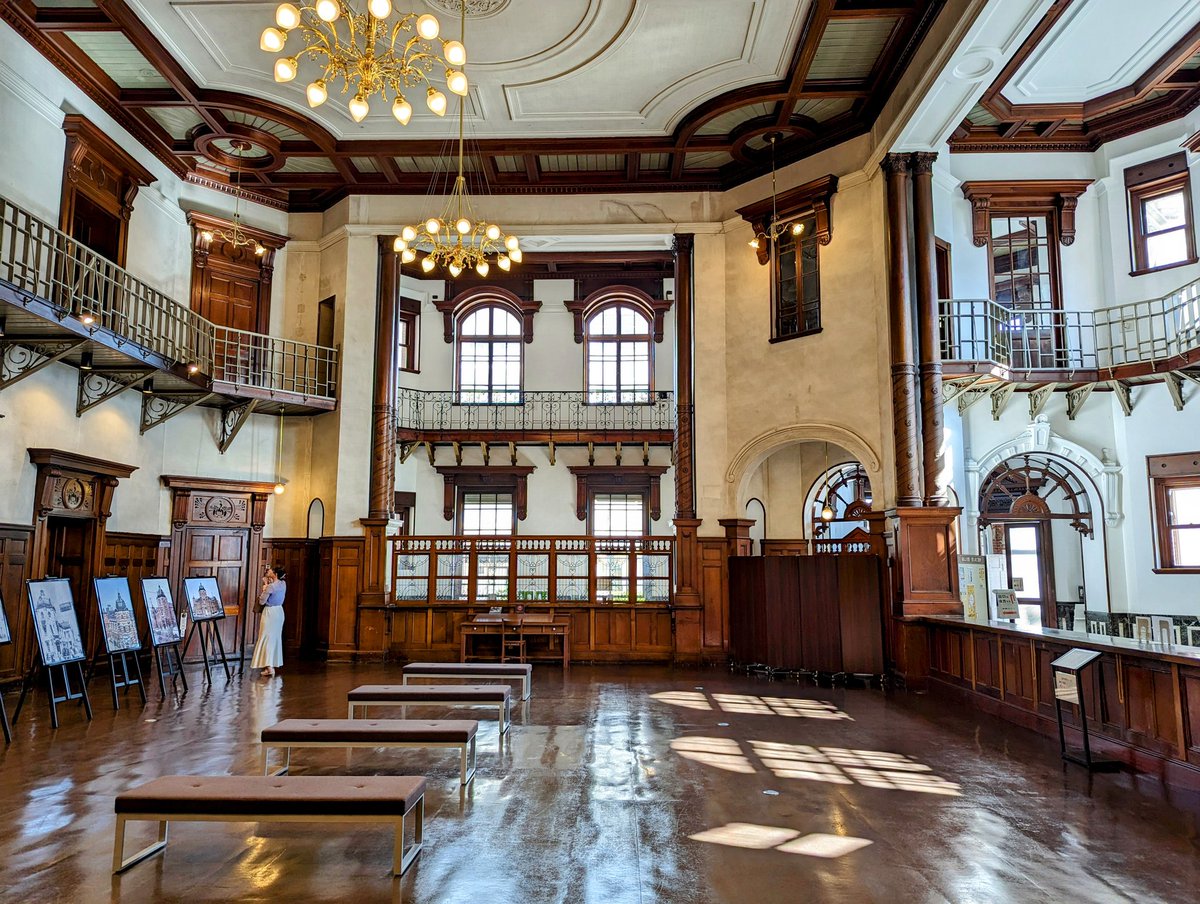
The Iwate Bank Red Brick Building in Morioka was built in 1911 as the head office of Morioka Bank, designed by Kingo Tatsuno and Manji Kasai. It is an Important Cultural Property of Japan, was used as a bank until 2012 and has been open to the public since 2016. In the high-ceilinged former banking hall, only the counters remain, with no customers and no clerks.
The Bunshokan in Yamagata is the former prefectural office and assembly hall built in 1916. It is an Important Cultural Property of Japan, was restored to its original appearance over about ten years and is now open free of charge. Beyond long corridors lie the former governor's office and meeting rooms where no one sits, filled with the stillness of a government building that has lost only its function.

Aizu and Hanamaki: A Spiral Where No One Passes, and a Department Store Dining Hall
Aizu Sazaedo, on Mt. Iimori in Aizuwakamatsu, is a hexagonal three-tiered wooden hall built in 1796. Inside is a double-helix ramp with separate paths up and down, and because it is one-way, you never pass another visitor. After spiraling up and back down, you find yourself leaving by a different door from the one you came in.
On the sixth floor of the Marukan Building, about a ten-minute walk from Hanamaki Station, the grand dining hall of the Marukan Department Store, which opened in 1973, lives on. The department store closed in 2016, but local people reopened the dining hall, and it is still running. Its wide room and high ceiling hold the air of a Showa-era department store dining hall just as it was.


Practical Notes for Visiting
Most of the places in this article are still places where people work and visit. When taking photos, take care not to capture staff, users or other visitors clearly, and avoid tripods and flash. Sendai Mediatheque houses a library, and the Marukan dining hall is a working restaurant.
Museums may close for exhibition changes or construction, and the Hakkoda Maru has more closing days in winter. Winters in Tohoku bring heavy snow and short days, so leave plenty of margin for time and weather.
If You Shoot It, Put It on the Map
Tohoku still has many old public buildings and retired structures that no one has recorded, and some views only appear on snowy days.
LIMap is a map for recording those places with photos and locations. If you find one, please add it.
FAQ
Where can I easily experience a liminal space in Sendai?
Try Sendai Mediatheque. It is about a seven-minute walk from Kotodai-Koen Station on the Namboku subway line, and you can enter for free from 9:00 to 22:00. The glass building is worth seeing from outside at night, and its floors have a particular stillness when few people are around.
Are there places I can visit for free?
Sendai Mediatheque, the Selion observation room and the Bunshokan are free to enter. The Hakkoda Maru, the Aomori Museum of Art's collection exhibition, the Iwate Bank Red Brick Building and Aizu Sazaedo charge admission.
Is it okay to visit in winter?
All of these places are open in winter, but some change their hours or closing days by season; for example, the Hakkoda Maru closes on Mondays from November to March. Snow can also slow travel, so check each facility's official information before you go.
Found a liminal space of your own?
Record the photo and location on LIMap, and share it with people who feel the same pull toward these places.
Open the LIMap map
If this article opened a door to somewhere new,
you can support LIMap on Ko-fi →
You Might Also Like
 Games
7 Games Where You Can Walk Through Liminal Spaces: The Exit 8, Pools, Escape the Backrooms and More
Games
7 Games Where You Can Walk Through Liminal Spaces: The Exit 8, Pools, Escape the Backrooms and More
 Games
What Is the Game Pools? The Poolrooms Game, and Real Places That Feel Like Pools
Games
What Is the Game Pools? The Poolrooms Game, and Real Places That Feel Like Pools
 Real Spots
Liminal Spaces in Shizuoka and Tokai: 8 Real Places, From Escalators of Light to a Showa-Era Station
Real Spots
Liminal Spaces in Shizuoka and Tokai: 8 Real Places, From Escalators of Light to a Showa-Era Station
 Real Spots
Liminal Spaces in North Kanto: 9 Real Places, From an Underground Quarry to the Top Floors of Prefectural Offices
Real Spots
Liminal Spaces in North Kanto: 9 Real Places, From an Underground Quarry to the Top Floors of Prefectural Offices