
Liminal Spaces in Okinawa: 7 Real Places, From a Beach Under an Elevated Road to Japan's Southernmost Arcade
Even in subtropical Okinawa, old arcades running behind the tourist streets, a beach hemmed in by an elevated road and concrete, and an exhibition hall left on the site of an expo are places anyone can visit. On a quiet morning or evening, you see a landscape that seems to have stopped partway, very different from the bright image of the tropics. Here are seven places registered on LIMap.

In Okinawa, Liminal Spaces Gather in Arcades and Man-Made Seaside Landscapes
The liminal spaces you find in Okinawa have two main features. The first is shopping arcades that shelter people from strong sun and rain. Right behind the busy tourist streets, long covered streets run past closed shutters and old signboards.
The second is landscapes made by people at the water's edge: an artificial beach with an elevated road running just offshore, a causeway built across shallow sea, a park on the site of an exposition. This article introduces places in Naha, Okinawa City, Uruma, Nago, Motobu and Ishigaki chosen on one condition: anyone can go there today.
Naha and Koza: Arcades Behind the Tourist Streets
Sunrise Naha is a covered shopping street behind Kokusai-dori in Naha, running from Ichiba-hondori toward Kainan. It dates back to the 1950s, and its arcade roof was built in 1988. Step one street away from the crowds and you find closed shutters, old signboards and small shops scattered under fluorescent lights, as if you had wandered into the back side of a tourist town.
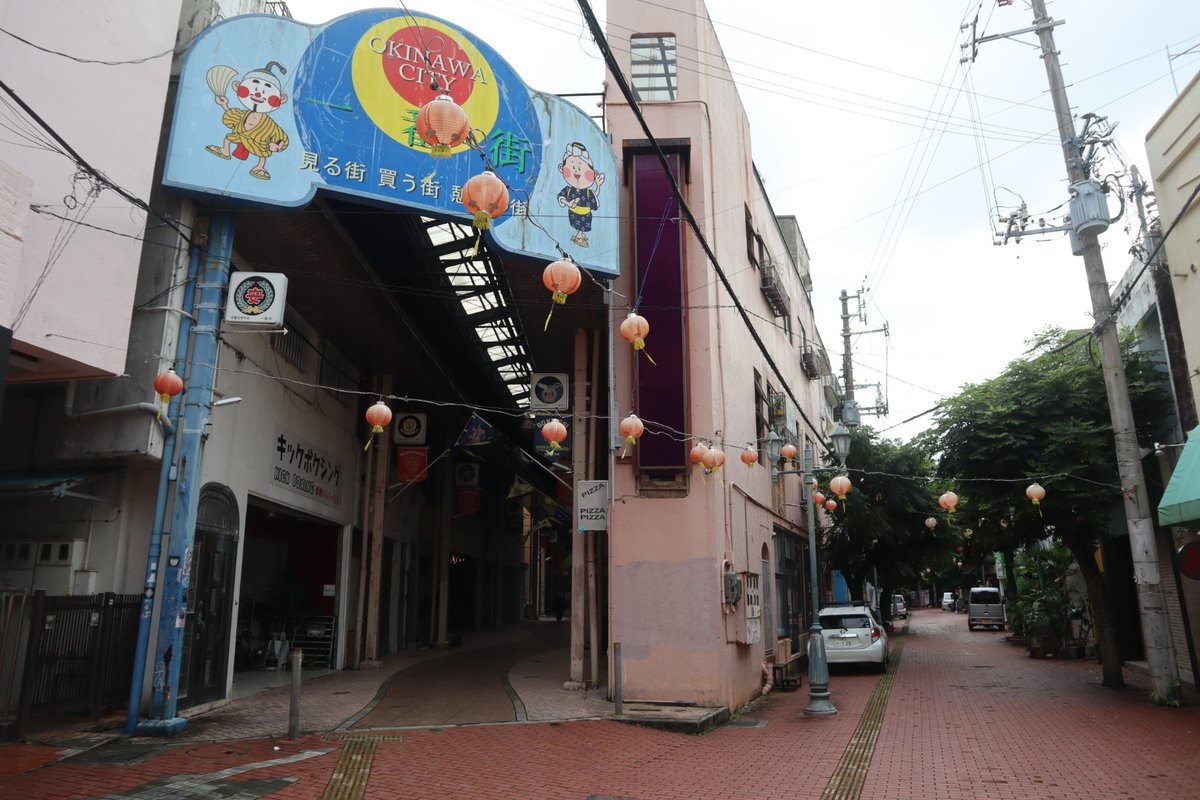
Ichibangai in Koza, Okinawa City, is a covered shopping street about 300 meters long. In the mid-1970s it became the first shopping street in Okinawa to get an arcade roof, and in the 1960s and 70s it was the busiest commercial district in central Okinawa. From the 1990s on, closed shops became common, and today new shops and long-shuttered ones alternate. The quiet under the long roof feels like an echo of livelier days.

A Beach Under an Elevated Road, and a Road Across the Sea
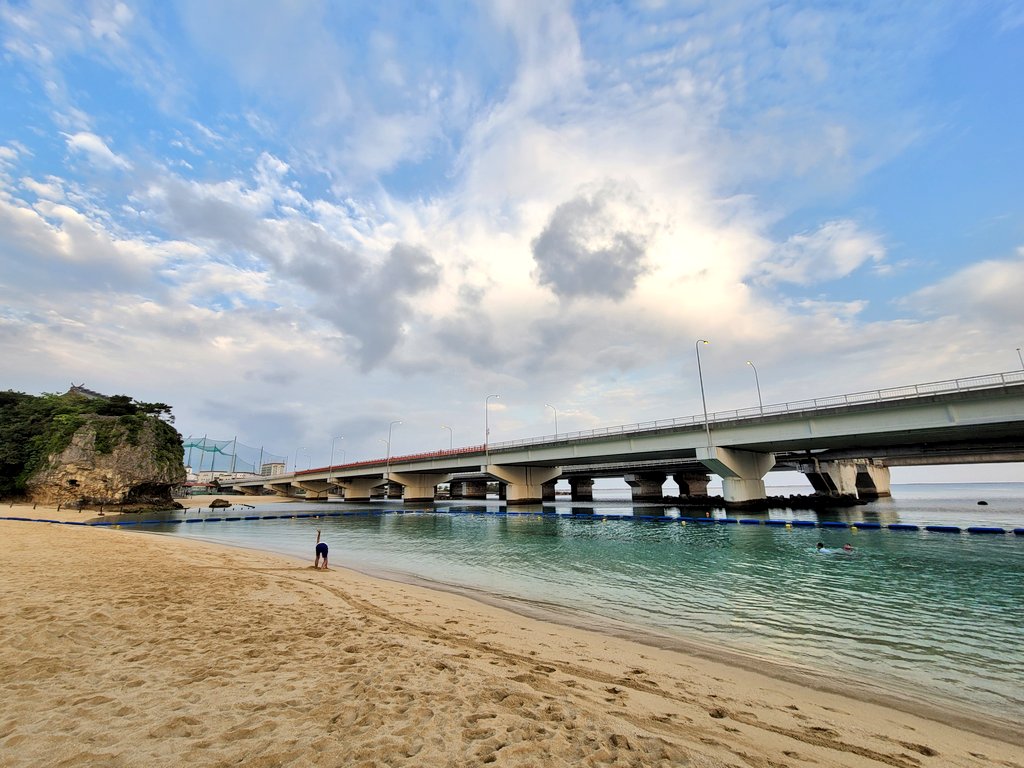
Naminoue Beach is the only swimming beach in Naha. It is an artificial beach built in 1991, with an elevated road crossing the sea right in front of it and Naminoue Shrine standing on the rocks above. Early in the morning or at night, with no swimmers, the tropical sand hemmed in by the overpass and concrete looks somehow artificial, like a stage set.
The Kaichu Doro in Uruma is a road about 5 kilometers long built on an embankment across shallow sea, linking the Yokatsu Peninsula and Henza Island. It opened in 1972. Partway along a straight road with nothing but sky and shallow water on either side, a wide parking area and a roadside station float alone. On a quiet weekday evening, it feels like driving along a road that never arrives anywhere.

A City Hall Open to the Wind, and an Exhibition Hall on an Expo Site
Nago City Hall, designed by Team Zoo (Atelier Zo), was completed in 1981. It was chosen in a design competition that drew 308 entries from across Japan and won the Architectural Institute of Japan Prize. Concrete block lattices and sunshade trellises are stacked in tiers, and semi-outdoor spaces open to the breeze appear throughout the building. On a quiet holiday or in the evening, with only the wind passing over its stepped terraces and long ramp, it feels neither quite like a government office nor quite like a village.
The Oceanic Culture Museum in Ocean Expo Park, Motobu, was built as the government pavilion for the 1975 Okinawa International Ocean Exposition. Much of its exhibition dates from the expo itself, and walking among large canoes and half-century-old displays feels like lingering after a festival has ended.


Ishigaki Island: Japan's Southernmost Arcade
Euglena Mall, in the center of Ishigaki Island, is the southernmost covered shopping street in Japan. Its two arcades were built in 1988 and 1989, with the public market between them.
It is busy with tourists during the day, but before the shops open in the morning or after they close, only long, dim passages remain, their roofs blocking the strong island sun. A quiet covered street at the edge of Japan.
 Euglena Mall (Ishigaki)
Practical Notes for Visiting
Shopping arcades are places where people work and live. Take care not to photograph shops, shopkeepers or passersby. Nago City Hall is a working city office, open to visitors only during weekday office hours. At Naminoue Beach, do not photograph people swimming.
On the Kaichu Doro, do not stop your car on the road or step into the roadway to take photos; shoot from the roadside station or the central plaza instead. Okinawa gets many typhoons from summer to autumn, and beaches and parks may close. The sun is strong, so bring water and shade.
If You Shoot It, Put It on the Map
Okinawa still has many old arcades and man-made seaside landscapes that no one has recorded. Right behind a tourist spot, there may be a view no one has photographed yet.
LIMap is a map for recording those places with photos and locations. If you find one, please add it.
FAQ
Where can I easily experience a liminal space in Naha?
Try Sunrise Naha, the covered shopping street behind Kokusai-dori. It is about a nine-minute walk from Makishi Station on the Yui Rail, and one street away from the crowds it becomes a quiet arcade. Mornings before the shops open are especially empty.
Are there places I can visit for free?
Sunrise Naha, Koza Ichibangai, the Euglena Mall arcades, Naminoue Beach and the Kaichu Doro are free. Ocean Expo Park is free to enter, but the Oceanic Culture Museum costs 190 yen for adults.
What happens during a typhoon?
When a typhoon approaches, Naminoue Beach may close and facilities in Ocean Expo Park may shut. If you visit between summer and autumn, check the weather forecast and each facility's official information.
Found a liminal space of your own?
Record the photo and location on LIMap, and share it with people who feel the same pull toward these places.
Open the LIMap map
If this article opened a door to somewhere new,
you can support LIMap on Ko-fi →
You Might Also Like
 Games
7 Games Where You Can Walk Through Liminal Spaces: The Exit 8, Pools, Escape the Backrooms and More
Games
7 Games Where You Can Walk Through Liminal Spaces: The Exit 8, Pools, Escape the Backrooms and More
 Games
What Is the Game Pools? The Poolrooms Game, and Real Places That Feel Like Pools
Games
What Is the Game Pools? The Poolrooms Game, and Real Places That Feel Like Pools
 Real Spots
Liminal Spaces in Shizuoka and Tokai: 8 Real Places, From Escalators of Light to a Showa-Era Station
Real Spots
Liminal Spaces in Shizuoka and Tokai: 8 Real Places, From Escalators of Light to a Showa-Era Station
 Real Spots
Liminal Spaces in North Kanto: 9 Real Places, From an Underground Quarry to the Top Floors of Prefectural Offices
Real Spots
Liminal Spaces in North Kanto: 9 Real Places, From an Underground Quarry to the Top Floors of Prefectural Offices