
Liminal Spaces in Hokuriku and Koshinetsu: 8 Real Places, From a Meiji-Era Railway Tunnel to a Library of Round Windows
In Hokuriku and Koshinetsu, tunnels you can now walk through after their original work ended, and open white libraries and museums, are places anyone can visit. At a quiet hour, long passages and wide spaces take on a stillness where you lose track of where you are headed. Here are eight places registered on LIMap.

In Hokuriku and Koshinetsu, Liminal Spaces Gather in Walk-Through Tunnels and Open White Architecture
The liminal spaces you find in Hokuriku and Koshinetsu have two main features. The first is long tunnels made for walking through. A Meiji-era railway tunnel has become a walking path, and a sightseeing tunnel dug into a mountain has been remade as a work of art. Straight passages with nothing but a line of lights feel so long you cannot see the end.
The second is open white public buildings from the 1990s onward: a library covered in round windows, a circular glass art museum, a cultural center joined to a station. When few people are around, only wide spaces with no fixed purpose remain. This article introduces places in Yamanashi, Niigata, Ishikawa, Toyama and Nagano chosen on one condition: anyone can go there today.
Two Tunnels: A Meiji-Era Railway Tunnel and a Passage of Light
The Ohikage Tunnel Walking Path in Koshu, Yamanashi Prefecture, was a Chuo Main Line railway tunnel opened in 1903. It fell out of use in 1997 when a new tunnel was built alongside it, and today you can walk its roughly 1.4 kilometers for free. Brick walls, soot from steam locomotives, rails and signs remain as they were, and you walk for about 30 minutes each way along a straight passage lit at regular intervals.
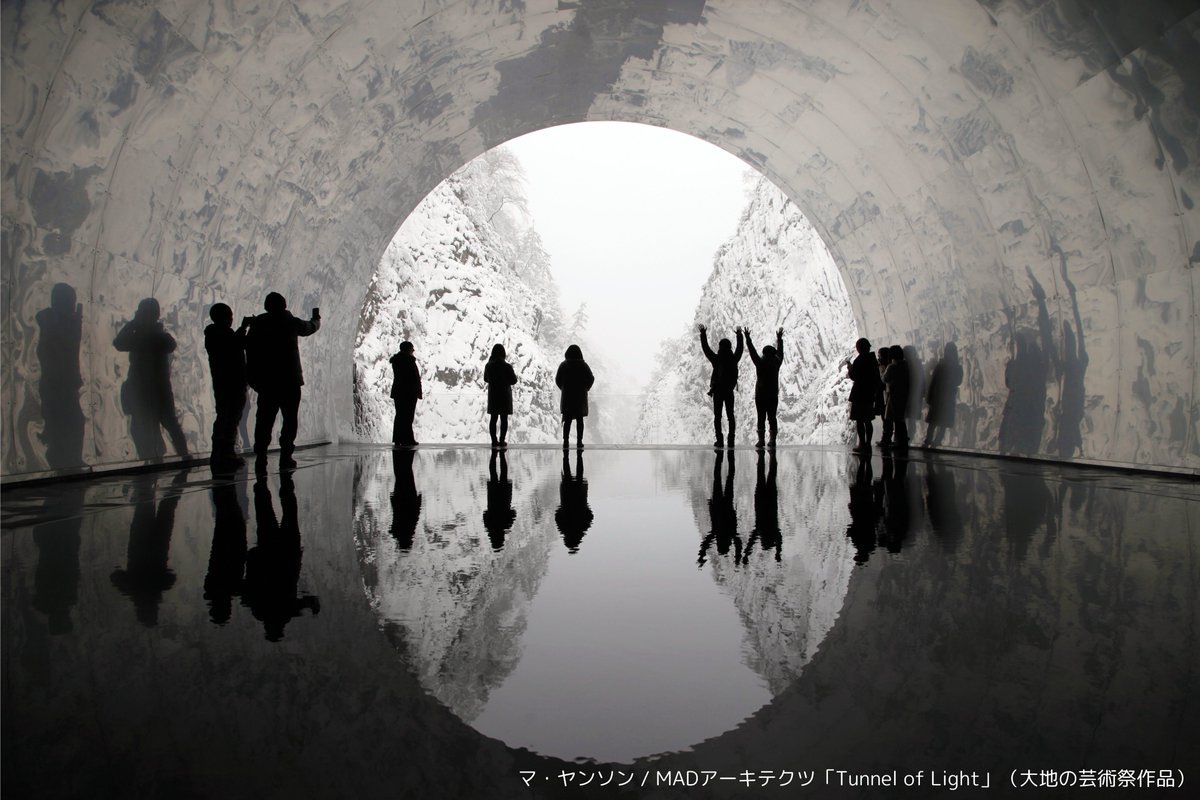
The Kiyotsu Gorge Tunnel in Tokamachi, Niigata Prefecture, is a 750-meter pedestrian tunnel built in 1996 to replace a gorge trail closed after a rockfall accident. For the 2018 Echigo-Tsumari Art Field, it was remade as "Tunnel of Light," a work by Ma Yansong / MAD Architects. At the end of a long passage of color-changing lights, the gorge is reflected like a mirror on a floor covered with water.

.jpg?width=1200)
Kanazawa: A White Box of Round Windows, and a Circular Glass Museum
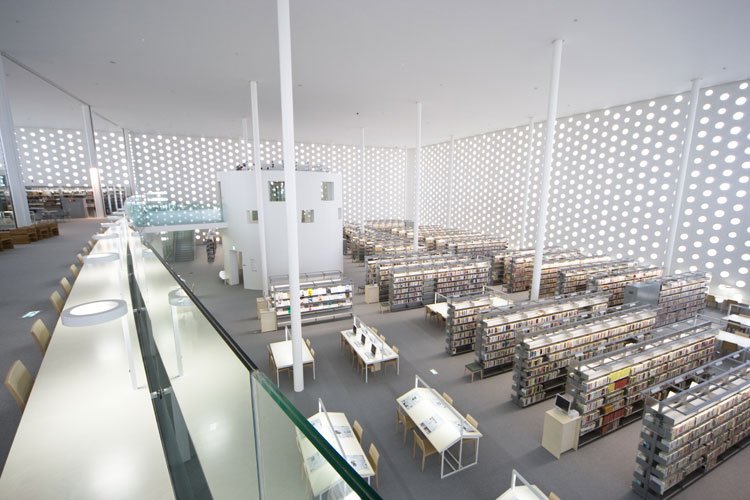
The Kanazawa Umimirai Library, designed by Coelacanth K&H, opened in 2011. About 6,000 round windows line its white box-like walls, and dots of light fall quietly into a tall, wide space. Set under the wide suburban sky, the white box looks slightly removed from reality even from outside. Taking photos inside requires permission.
The 21st Century Museum of Contemporary Art, Kanazawa, designed by SANAA, opened in 2004. Inside a circular glass building 112.5 meters across, white corridors and courtyards connect like a maze. Its free public zone is open until 22:00, and at night, with fewer people around, you can no longer tell which side is the front and which is the back.

Toyama and Niigata: A Bridge With a String Telephone, and a Free Observation Deck
Fugan Canal Kansui Park, north of Toyama Station, is an artificial waterside park opened in 1997 on the site of a canal basin. Observation towers about 20 meters tall stand at both ends of the Tenmon Bridge, connected by a "red string telephone." At night or early in the morning, when only the bridge lights are reflected on the empty water, it has the stillness of a stage prepared for someone and then forgotten.
On the 31st floor of the Bandaijima Building at Toki Messe, facing Niigata Port, is a free observation room about 125 meters up. At night, from the quiet glass-walled floor, you see only the city lights and the dark Sea of Japan. When few people are there, the room falls as silent as a waiting room going nowhere.
 Fugan Canal Kansui Park, Tenmon Bridge
 Toki Messe Befco Bakauke Observation Room
A Cultural Center Joined to a Station, and a Mining Ruin on Sado
The Chino Cultural Complex in Nagano Prefecture, designed by Nobuaki Furuya, opened in 2005. A passage from the elevated Chino Station building runs straight into it, blurring the line between station and building. Its reading room, a long glass-walled space running beside the station platform, puts the place where you wait for a train and the place where you read on either side of a single pane of glass.
The Kitazawa Flotation Plant on Sado Island is the site of a processing plant for ore from the Sado gold mine. It was built between 1937 and 1940 and closed in 1952. Today, stepped concrete structures climb the hillside next to a 50-meter thickener, and the site is sometimes called "Sado's Laputa." The plaza in front has been landscaped, so anyone can view it up close.


Practical Notes for Visiting
Libraries, museums and cultural centers are places people use. The Kanazawa Umimirai Library requires a permit to take photos inside and does not allow photography in the book areas. The 21st Century Museum bans flash, tripods and selfie sticks. Wherever you go, take care not to capture other visitors clearly.
The Ohikage Tunnel is open from 9:00 to 16:00 and takes about 30 minutes each way. The Kiyotsu Gorge Tunnel requires reservations on some busy days and may close for snow in winter. The 21st Century Museum is scheduled to close for major repairs from May 2027. The structures at the Kitazawa Flotation Plant are aging, so stay out of areas that are off-limits.
If You Shoot It, Put It on the Map
Hokuriku and Koshinetsu still have many tunnels and quiet white public buildings that no one has recorded, and some views only appear on snowy days.
LIMap is a map for recording those places with photos and locations. If you find one, please add it.
FAQ
Can anyone walk through the Ohikage Tunnel?
Yes. It is free and open from 9:00 to 16:00 (closed over the New Year holidays). It is about a five-minute walk from Katsunuma-budokyo Station on the JR Chuo Main Line, and the tunnel is about 1.4 kilometers long, taking about 30 minutes each way.
Are there places I can visit for free?
The Ohikage Tunnel Walking Path, the Tenmon Bridge observation towers at Kansui Park, the Toki Messe observation room, the Kanazawa Umimirai Library and the free zone of the 21st Century Museum are free. The Kiyotsu Gorge Tunnel charges admission (1,200 yen for adults, 1,000 yen in winter).
Do I need a reservation for the Kiyotsu Gorge Tunnel?
Only on busy days such as holidays, which are announced on the official website. For photos with few people, weekday mornings are best.
Found a liminal space of your own?
Record the photo and location on LIMap, and share it with people who feel the same pull toward these places.
Open the LIMap map
If this article opened a door to somewhere new,
you can support LIMap on Ko-fi →
You Might Also Like
 Games
7 Games Where You Can Walk Through Liminal Spaces: The Exit 8, Pools, Escape the Backrooms and More
Games
7 Games Where You Can Walk Through Liminal Spaces: The Exit 8, Pools, Escape the Backrooms and More
 Games
What Is the Game Pools? The Poolrooms Game, and Real Places That Feel Like Pools
Games
What Is the Game Pools? The Poolrooms Game, and Real Places That Feel Like Pools
 Real Spots
Liminal Spaces in Shizuoka and Tokai: 8 Real Places, From Escalators of Light to a Showa-Era Station
Real Spots
Liminal Spaces in Shizuoka and Tokai: 8 Real Places, From Escalators of Light to a Showa-Era Station
 Real Spots
Liminal Spaces in North Kanto: 9 Real Places, From an Underground Quarry to the Top Floors of Prefectural Offices
Real Spots
Liminal Spaces in North Kanto: 9 Real Places, From an Underground Quarry to the Top Floors of Prefectural Offices