
Liminal Spaces in Tokyo: 8 Real Places, From Deep Station Passages to a Rooftop Ferris Wheel
Tokyo is laced with passages linking station to station and building to building, and buildings made for Showa-era entertainment are still in business. Walk them when few people are around, and familiar places suddenly feel unfamiliar. Here are eight places on LIMap that anyone can visit, and two spaces that appeared in Tokyo for the release of the film The Backrooms.

Tokyo's Liminal Spaces Live "Between Transfers" and in Showa-Era Entertainment
Beneath Tokyo runs a web of passages connecting stations and buildings. Most of them exist only to be passed through on the way somewhere else. Passages packed with commuters in the morning and evening fall quiet early in the morning or late at night, and that contrast is one of the defining features of liminal spaces in Tokyo.
The other is that places built for Showa-era leisure are still in use: an underground row of eateries, a building with a cinema and a bowling alley, an amusement park on a department store roof. Right beside the newer city, time seems to move differently.
Deep Under Tokyo Station: The Long Passage to the Keiyo Line
The Keiyo Line platforms at Tokyo Station sit deep underground, far from the station's other platforms. When the Keiyo Line arrived in March 1990, it used underground space originally planned as the station for the Narita Shinkansen, whose construction had stopped around 1983. To transfer, you walk a long connecting passage lined with moving walkways, known as the Bay Road.
View the post on X ↗
Being carried along the moving walkways past the same scenery is the very feeling of being on the way somewhere. Late at night after the commuter rush, or early on a holiday morning, the passage empties almost completely.
Marunouchi and Shiodome: Walking Beneath the Office Districts
The Gyoko underground passage runs straight beneath Gyoko-dori in Marunouchi, from Tokyo Station toward the Imperial Palace. It was converted from an underground car park completed in 1960 and opened to pedestrians in 2007. The glass showcases along its walls, known as the Gyoko Underground Gallery, continue for about 220 meters. On weekend mornings, almost no one walks this straight, column-lined corridor.
View the post on Instagram ↗
From Shimbashi to the Shiodome high-rises there are three routes: at street level, underground, and on a second-floor pedestrian deck. The underground route, the Shiodome Sio-Site underground walkway, links JR Shimbashi Station's Shiodome exit with Shiodome Station on the Toei Oedo Line. In contrast to the glittering towers above, it is a passage of concrete and light.
View the post on Instagram ↗

Where the Showa Era Remains: Asakusa Underground Street and Rosa Kaikan
The Asakusa Underground Shopping Street opened in 1955. Among underground shopping streets built after the war, it is said to be the oldest still in existence in Japan. Its entrance is just outside the ticket gates of Asakusa Station on the Tokyo Metro Ginza Line, and eateries and a barber line a low passage about 50 meters long. Right below the busy tourist streets of Asakusa, a completely different time flows.
View the post on Instagram ↗
Rosa Kaikan, at the west exit of Ikebukuro Station, opened in 1968 as an all-in-one amusement building. It grew out of the Cinema Rosa movie theater, which opened in 1946, and still houses a bowling alley, a game center, a live music venue and restaurants. Its winding corridors and old signs carry the air of a Showa-era entertainment building. It lies within the Ikebukuro west exit redevelopment area and is expected to be rebuilt eventually.
View the post on Instagram ↗
A Rooftop Ferris Wheel and a Ropeway Station by the Lake
On the roof of Tokyu Plaza Kamata, in front of Kamata Station, is Kamataen, a small amusement park that has been there since 1968. Its "Ferris Wheel of Happiness", the only rooftop Ferris wheel in Tokyo, is the third generation: it was due to be removed in 2014, but after calls to keep it, it was reinstalled following renovation. Riding a slowly turning gondola above the crowds around the station feels somehow detached from reality.
View the post on Instagram ↗
By Lake Okutama stand the remains of the Okutama Lake Ropeway, which opened in 1962. It stopped running in the winter of 1966 for a "winter break" and never reopened. A gondola still remains at the former Kawano Station. Entry is prohibited and there is a risk of collapse, so do not approach it; look only from a distance.
View the post on X ↗
A Late-Night Passage, and the "Backrooms" a Film Brought to Tokyo
At Tokyo Dome City, the underground passage to LaQua, which opened in 2003, takes on the look of somewhere else near closing time, when few people are around, with its distinctive colors and close, still air. Have a look at the photos posted to LIMap.
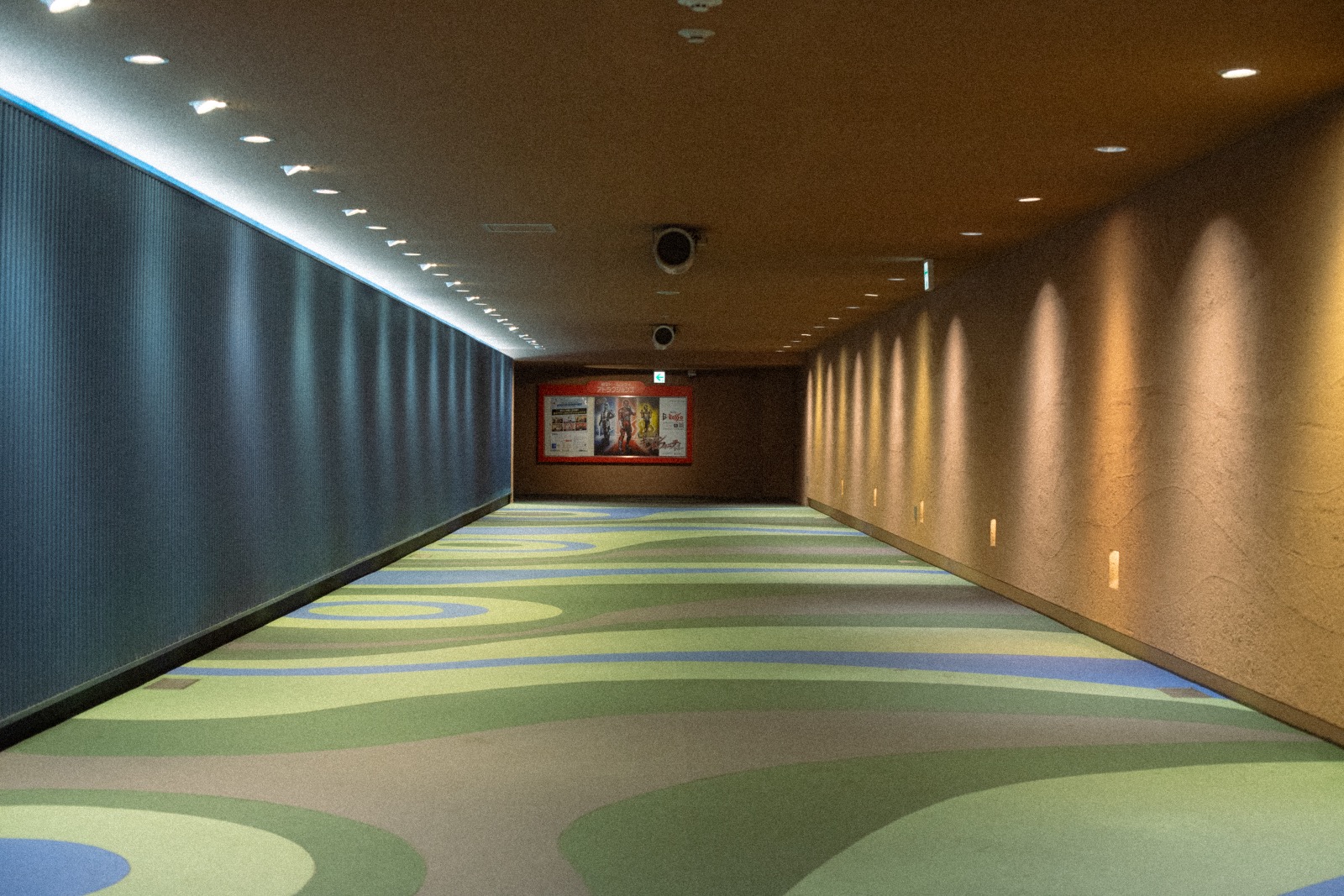 Underground passage to LaQua, Tokyo Dome City
When the film The Backrooms opened in Japan on September 4, 2026, two limited-time "Backrooms" appeared in Tokyo. At Sunshine City Exhibition Hall A in Ikebukuro, the hands-on event Q LIMINAL ran from September 11 to 20. In Akasaka, a life-size recreation of a scene from the film filled an empty second-floor office and could be seen through the glass from September 1 to 13. Both have ended, and the Akasaka room is now an ordinary vacant office, so please do not go looking for it.
View the post on X ↗
View the post on X ↗
Practical Notes for Visiting
Station passages, underground streets and commercial buildings are places where people work and pass through. When taking photos, keep shops and faces out of the frame, and do not set up tripods or block the way. Some underground passages are only open at certain hours. Kamataen is open from 10:00 to 18:00 (until 17:00 in winter), and the Ferris wheel and other rides stop in bad weather or when a heatstroke alert is in effect.
Disused facilities like the Okutama Lake Ropeway are off-limits. Do not go past fences or signs; view them only from outside. Also note that the irregular lights at Kiyosumi-shirakawa Station, the model for one of the anomalies in the game The Exit 8, were removed during LED work between 2025 and 2026.
If You Shoot It, Put It on the Map
Tokyo still has many passages and old buildings no one has recorded. The transfer passage you walk every day may be exactly the scene someone else has been looking for. If the film got you interested, also read "Places in Tokyo That Feel Like the Backrooms, for After the Film."
LIMap is a map for keeping places like these, with photos and locations. If you find one, please add it.
FAQ
Where can I easily feel a liminal atmosphere in Tokyo?
The long passage to the Keiyo Line platforms at Tokyo Station and the Gyoko underground passage in Marunouchi can both be reached directly from the station and cost nothing to walk. Early mornings, late nights and weekend mornings are best.
Can I still see the Exit 8-like lights at Kiyosumi-shirakawa Station?
No. The irregularly placed lights were removed during LED work between 2025 and 2026, and only their traces remain on the ceiling.
Can I still visit the Backrooms film exhibitions?
No. Both Q LIMINAL at Sunshine City (September 11–20, 2026) and the life-size display in Akasaka (September 1–13) have ended.
Found a liminal space of your own?
Record the photo and location on LIMap, and share it with people who feel the same pull toward these places.
Open the LIMap map
If this article opened a door to somewhere new,
you can support LIMap on Ko-fi →
You Might Also Like
.jpg?width=600) Real Spots
Where to Go in Tokyo After Watching the Backrooms Movie
Real Spots
Where to Go in Tokyo After Watching the Backrooms Movie
 Real Spots
Liminal Spaces in North Kanto: 9 Real Places, From an Underground Quarry to the Top Floors of Prefectural Offices
Real Spots
Liminal Spaces in North Kanto: 9 Real Places, From an Underground Quarry to the Top Floors of Prefectural Offices
 Real Spots
Is "Exit 8" Real? Looking for Actual Places With the Same Eerie Vibe
Real Spots
Is "Exit 8" Real? Looking for Actual Places With the Same Eerie Vibe
.jpg?width=600) Basics
What Is a Liminal Space? Meaning, Origin, and Real-World Examples
Basics
What Is a Liminal Space? Meaning, Origin, and Real-World Examples