
Do You Need to Do Homework Before Watching Backrooms? The Legend, the YouTube Series, and the Director
Backrooms finally opened in Japan on September 4, 2026. It began as an internet urban legend, was turned into film by a sixteen-year-old on YouTube, and was then directed for the screen by that same person. Do you need to prepare before seeing it? Here is the short answer, followed by the legend's history, the original YouTube series, and the director's story.

The Short Answer: You Can Go In Cold — But Five Minutes of Context Changes What You See
Let us get this out of the way first. Backrooms is built to work as a self-contained story. The setting and the characters are explained on screen, so no homework is strictly required.
That said, the film sits on top of a long internet history: an urban legend born on an anonymous message board in 2019, a sixteen-year-old YouTuber who turned it into a worldwide phenomenon, and that same person making his feature directing debut. Knowing that chain of events genuinely changes what the yellow room on screen means to you.
There is one more reason to read on. The Japanese release is the Everything Must Go Edition, which adds sixteen minutes of extra footage after the main feature. That footage was made in the language of the original YouTube series, so a little background keeps you with it right to the end.
A History of the Backrooms: It Started With One Photo on 4chan
It all began on May 12, 2019. A thread on 4chan's paranormal board (/x/) asked people to post images that just feel off, and someone uploaded a single photograph: yellowed wallpaper, fluorescent tubes, wall-to-wall carpet, and no people at all in a room with no obvious purpose.
Another anonymous user replied, and that reply created the mythology. If you noclip out of reality, you fall into this place: identical rooms repeating endlessly, the low hum of fluorescent lights, the smell of damp carpet. That short post is the foundation everything since has been built on.
Within days the idea spread to Reddit and to dedicated wikis on Wikidot and Fandom, where contributors added a hierarchy of Levels and the entities that inhabit them. The defining trait of this legend is that it grew as collaborative fiction with no single author.
The source of the original photograph stayed a mystery for years, until internet researchers traced it in May 2024. It was taken in June 2002 in Oshkosh, Wisconsin, on the second floor of a building that had been a furniture store and was mid-renovation. The film making its protagonist a furniture store owner is almost certainly a nod to that fact.
.jpg?width=1200)
The Source Material: Kane Pixels' YouTube Series (2022–2026)
What turned a message-board premise into a visual language was a nine-minute short uploaded to YouTube on January 7, 2022: The Backrooms (Found Footage). It was made by Kane Parsons, then sixteen, posting as Kane Pixels. Shot to look like a 1990s home video, it follows a boy with a camcorder who stumbles into the yellow rooms — and it drew somewhere around eighty million views on its own.
The tools were Blender and Adobe After Effects, nothing more. Parsons handled the modelling, the editing and the music essentially by himself, and the first episode took him about a month.
The short grew into a twenty-five episode series. Its spine is the Async Research Institute, a fictional 1990s organisation that discovered a doorway to another dimension during MRI research. Built from fragmentary expedition records and civilian encounter footage, the series has accumulated roughly 197 million views.
If you only watch one thing beforehand, make it episode one. Nine minutes is enough to understand exactly what atmosphere the film is reaching for. If you have more time, the finale, Everything Must Go, went up on YouTube on August 18, 2026 — and it connects directly to the sixteen minutes attached to the Japanese release.
Director Kane Parsons: An A24 Debut at Twenty
Parsons was born on June 18, 2005 in Petaluma, California. His father is a visual effects artist, and he started making videos in 2017. Before the Backrooms he had already released Project 209 and Attack on Titan (Historical Footage), which restaged the anime as if it were real wartime documentary footage.
The turning point came about a month after episode one. Multiple studios approached him about a feature, and by February 2023 the project was formally underway with A24 at its centre. He was seventeen. Filming took place in the summer of 2025 in Vancouver, on more than 30,000 square feet of sets across four sound stages. He was nineteen.
When the film opened in May 2026 he was twenty — the youngest director ever to debut at number one both domestically and worldwide. Made for ten million dollars, it has grossed over three hundred million globally, making it A24's biggest release to date (88% on Rotten Tomatoes, 77 on Metacritic).
In mid-2026 he also publicly criticised the use of generative AI in filmmaking, saying it defeats the purpose entirely. Coming from someone who got here with Blender and a laptop, it says something about how the film itself was made.
The Plot, and What to Know About the Japanese Release
The film follows Clark (Chiwetel Ejiofor), a furniture store owner struggling with alcoholism, who finds a space behind reality through his store's basement. His therapist, Dr. Mary Kline (Renate Reinsve), and others around him are pulled in as well, into a labyrinth of yellow rooms and malformed furniture.
In Japan the film opened on September 4, 2026, distributed by Happinet Phantom Studios. What screens is the Everything Must Go Edition: roughly 110 minutes of feature plus sixteen minutes of extra footage, 126 minutes in total, and Japan gets this version from opening day. Those sixteen minutes are presented as an Async investigation record dated June 18, 1990, bridging the film and the web series. Do not leave your seat when the credits start.
So: homework is optional. But hold on to three things — one photo from 2019, one nine-minute short from 2022, and a twenty-year-old director — and the same 126 minutes will give you noticeably more.
And the Backrooms Exist Outside the Screen, Too
The reason this film landed so widely is that its space is not pure invention. It distils a feeling we pass through all the time: an empty station at 2am, a mall after closing, an underground passage lit only by fluorescent tubes. Online, that feeling has a name — liminal space.
LIMap collects real places in Japan that carry something close to that Backrooms air. Before or after the film, take a look at the entrances on the real-world side.

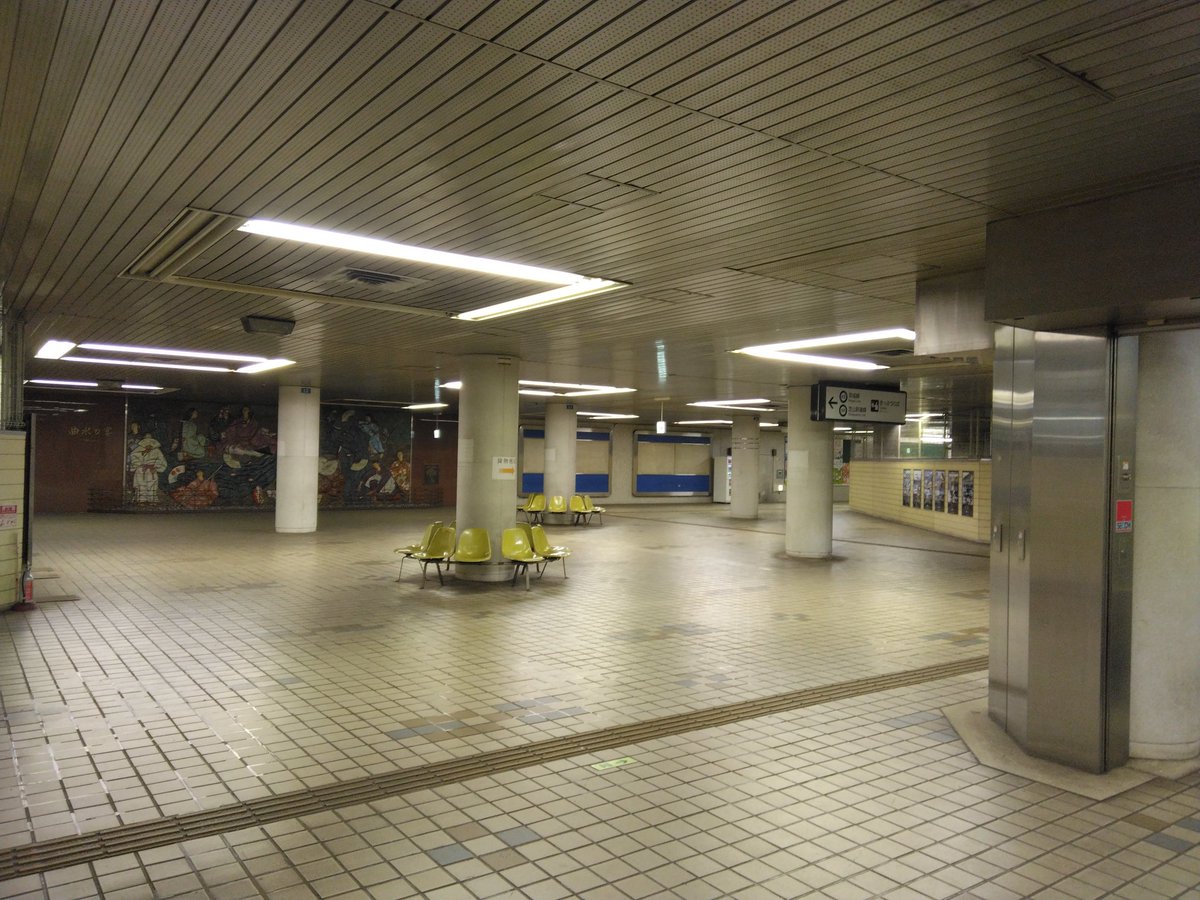

For more on Backrooms-like places in Japan, see our article Do the Backrooms Exist in Japan?
And if you come across somewhere that feels like the film, record the photo and the location on LIMap. Someone else is out there looking for exactly that feeling.
Found a liminal space of your own?
Record the photo and location on LIMap, and share it with people who feel the same pull toward these places.
Open the LIMap map
If this article opened a door to somewhere new,
you can support LIMap on Ko-fi →
You Might Also Like
 Games
7 Games Where You Can Walk Through Liminal Spaces: The Exit 8, Pools, Escape the Backrooms and More
Games
7 Games Where You Can Walk Through Liminal Spaces: The Exit 8, Pools, Escape the Backrooms and More
 Games
What Is the Game Pools? The Poolrooms Game, and Real Places That Feel Like Pools
Games
What Is the Game Pools? The Poolrooms Game, and Real Places That Feel Like Pools
 Real Spots
Liminal Spaces in Shizuoka and Tokai: 8 Real Places, From Escalators of Light to a Showa-Era Station
Real Spots
Liminal Spaces in Shizuoka and Tokai: 8 Real Places, From Escalators of Light to a Showa-Era Station
 Real Spots
Liminal Spaces in North Kanto: 9 Real Places, From an Underground Quarry to the Top Floors of Prefectural Offices
Real Spots
Liminal Spaces in North Kanto: 9 Real Places, From an Underground Quarry to the Top Floors of Prefectural Offices